
How Variable Frequency Drive HVAC Motors Accelerate Facility Decarbonization
Industrial decarbonization is imperative, and HVAC systems are key. ABB expert Yann Bottoli points out that adopting variable frequency drive motors can significantly reduce energy consumption and carbon emissions. Its LV Titanium motor, with its compact design and plug-and-play features, is helping facilities overcome adoption barriers and accelerate the journey toward net zero.
Editor's note:Yann Bottoli is the Global Sales Manager for IEC Low Voltage Motors at ABB. The views expressed in this article are those of the author alone.
For industrial enterprises, the transition to net-zero emissions is no longer a question of "whether," but "when" and "how quickly and easily it can be achieved." Heating, ventilation, and air conditioning (HVAC) systems are part of the solution. According to the World Green Building Council, energy used for heating, cooling, and powering buildings accounts for 28% of global energy-related carbon emissions.
The key to decarbonizing HVAC lies in the ability to adopt and promote energy-efficient technologies in these systems on a large scale. The motors that power fans, air handling units, heat pumps, and compressors are at the heart of this issue.
Variable Frequency Control: From "Full-Speed Idling" to On-Demand Energy Supply
For decades, fixed-speed induction motors have been the mainstream choice, but they often operate at full load, with speed typically adjusted through mechanical means. This is like driving a car with one foot on the accelerator and the other on the brake to adjust speed—it consumes more fuel, wastes energy, and produces unnecessary emissions. A new generation of variable speed drive (VSD) motors aims to solve this problem.
VSDs control energy output by adjusting the motor speed to match actual demand, ensuring that only the necessary energy is used. Shifting from fixed-speed to variable-speed operation can reduce energy consumption by up to 50%. At the same time, it reduces heat and mechanical wear between components, thereby decreasing the need for replacements and repairs and extending service life. Reduced maintenance requirements also mean lower demand for new materials and the energy used in manufacturing, thus reducing the machine's carbon footprint.

Overcoming Adoption Barriers: Making Decarbonization Accessible
Despite the clear benefits, ABB estimates that only about a quarter of motors currently in operation are controlled by VSDs. The HVAC industry faces a similar situation. Many operators are concerned about the logistical issues of adopting variable frequency control, including installation complexity, system downtime, and equipment integration. Due to these concerns, equipment upgrades are often seen as a hassle. ABB believes that its LV Titanium variable speed motor (VSM) can eliminate these installation barriers.
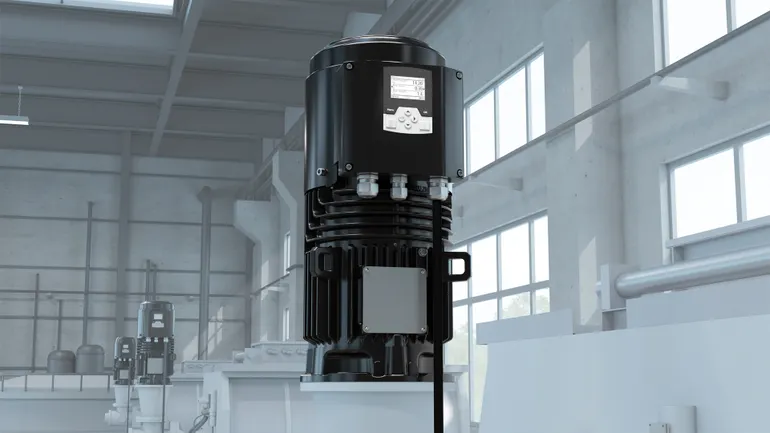
The LV Titanium is designed as a streamlined solution. It integrates an IE5 ultra-premium efficiency permanent magnet motor with a dedicated drive in a compact unit, automatically achieving energy savings through built-in variable frequency control.
Data compiled by ABB shows that compared to standard IE3 motors, the LV Titanium can reduce energy losses by up to 40%, cutting carbon emissions by 11,600 kilograms annually. For a motor operating 6,000 hours per year, over a 15-year lifespan, this equates to savings of approximately $140,026 and a reduction of 174,000 kilograms of carbon emissions.
Equally important is addressing practical adoption barriers. The LV Titanium is up to three times smaller than comparable induction motors and features plug-and-play functionality for easy installation and commissioning. Its design allows it to adapt to various installation needs, enhancing efficiency whether in new systems or upgrades to existing ones.
While earlier models required connecting two separate components on site, the LV Titanium is delivered as a pre-configured, factory-assembled all-in-one unit ready for direct deployment. The ease of installation is especially valuable for teams lacking complex installation resources, while also significantly reducing the extended downtime typically associated with equipment upgrades. This is particularly important for temperature- and airflow-sensitive infrastructure such as hospitals, hotels, data centers, or office buildings, where operational disruption is unacceptable.
Investing in the Future: Decarbonizing from the Motor Core
The global decarbonization trend is not fading. Rising temperatures are driving demand for efficient HVAC systems, and sustainability regulations are tightening. Easy-to-adopt motor technology is crucial to meeting this demand at the pace operators expect.
The LV Titanium demonstrates that future-ready performance doesn't have to be complex—it just needs to be built in from the start. Any operator of fans, pumps, chillers, or boilers can thereby boost productivity and ensure long-term operational stability. ABB believes that the path to decarbonization begins with smarter decisions at the core of every HVAC system.