
Adding protective layers to system diagrams can reduce the risk of industrial refrigeration failures
Industrial ammonia refrigeration systems ensure food safety but also carry high risks. A Cargill engineering manager proposed the LOOP-BAR framework, which directly overlays safety protection layers on system diagrams, enabling operations, maintenance, and engineering teams to share the same safety view and reduce potential hazards.
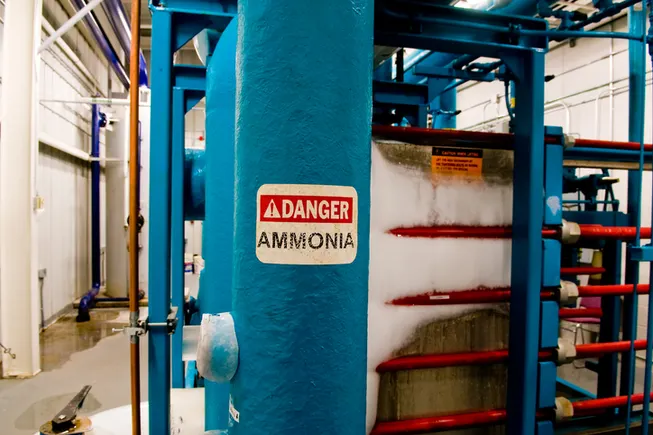
Industrial ammonia refrigeration systems ensure food safety while being efficient energy users, but when a failure occurs, the consequences can escalate rapidly. To help employees manage risks, plants typically equip themselves with piping and instrumentation diagrams, operating procedures, maintenance plans, emergency response plans, and alarm systems. The problem is that these resources are often stored in different systems, lacking interconnection, making it difficult for teams to call upon them uniformly in daily operations. This gap is where hidden hazards reside.
The LOOP-BAR framework aims to solve this problem by making process safety "visible." It overlays layers of protection directly onto a simplified ammonia refrigeration system diagram, showing not only the equipment in use but also the mechanisms of the protection systems, the responsible person for each protective measure, and how the team confirms its effective operation. Although the framework was developed from the perspective of industrial ammonia refrigeration systems, it can technically be extended to other chemical process industries or areas that heavily rely on preventive maintenance, protective measures, and functional testing.
Replacing documents with diagrams
Operators and technicians typically learn refrigeration systems visually through diagrams of compressors, condensers, receivers, valves, and evaporators, while learning process safety management (PSM) often treats it as a checklist of requirements. When safety elements are not integrated on the same page as the operational diagram, the following situations can occur: control measures are mistaken for protective measures; protective measures are assumed to exist without verification; multiple "layers" quietly rely on the same sensor or power supply; and accountability for barriers becomes ambiguous.

What our team calls LOOP-BAR places the safety architecture and the refrigeration process on the same page, establishing a common language among operations, maintenance, engineering, and leadership.
What truly counts as a layer of protection?
Drawing on the Layer of Protection Analysis (LOPA) methodology, LOOP-BAR applies a simple test: a layer of protection must perform a specific action at a defined trigger point and be verifiable. Not all protective measures meet this criterion.
Basic control loops keep the plant running normally, while layers of protection safeguard people and the community under abnormal conditions.
Each layer in LOOP-BAR is defined by clear triggering conditions and actions, independence from other layers, performance standards (setpoints, response times, test methods), a clearly assigned responsible person, and objective evidence of operation.
If a protective measure cannot meet these criteria, it is treated as an auxiliary measure and not counted as an independent layer of protection.
Turning the diagram into a barrier assurance register
At the heart of LOOP-BAR is the Barrier Assurance Register (BAR). For each layer of protection shown on the diagram, the BAR records the function of that barrier, its location in the system, the responsible person, the testing frequency, and where the evidence is stored—whether in a CMMS, calibration records, drills, or inspection reports.

Safety information is no longer scattered across binders and databases; teams gain a single, traceable view of barrier health.
Receiver overpressure scenario
Consider a common scenario: liquid ammonia is contained in a high-pressure receiver. The consequences could be a relief valve lifting, a toxic release, and emergency response activation. With LOOP-BAR, the team can immediately determine whether the scenario is protected by a balanced set of layers of protection:
- A properly sized and well-maintained relief valve.
- A high-pressure alarm with a trained operator response.
- A high-pressure shutdown or interlock.
- A proven pump-down and valve alignment procedure.
- Ammonia detection and ventilation response.
Equally important, the framework can reveal whether these layers are truly independent or whether multiple layers rely on the same transmitter, programmable logic controller (PLC), or manual operator action window.
How plants actually use it
LOOP-BAR is not a one-time study. Plants use the overlay diagram and BAR in the following scenarios: shift handover discussions, maintenance planning and line-opening reviews, process hazard analysis and LOPA revalidation, management of change and pre-startup safety reviews, audit preparation, or incident investigations.
When barrier tests are overdue or detectors are bypassed, the issue immediately surfaces as a leading indicator rather than appearing months later as an audit finding.
Why it matters
Strong process safety management is not just about compliance; it is about whether layers of protection are real, have clear owners, are tested, and are understood by the people closest to the system. By presenting safety elements on the same diagram that teams already trust, LOOP-BAR helps organizations identify weak or interdependent barriers early and intervene before near misses escalate into incidents.
In ammonia refrigeration, where the margin for error is extremely limited, clarity itself constitutes a safety system.