
How Heat Pump Technology Is Reshaping the Future of High-Performance Facilities
Heat pump technology is becoming a key pathway for decarbonization and energy savings in high-performance facilities such as hospitals, airports, and schools. By transferring heat rather than burning fuel, heat pumps can significantly improve energy efficiency, reduce operating costs, and support multiple application scenarios. Despite challenges such as high initial investment and insufficient market awareness, with technological advancements and policy support, heat pumps are expected to become a core solution for building electrification in the future.
Ned Greene is associate principal at PAE Engineers. Views are the author’s own.
In hospitals, airports, schools, and other multifunctional facilities, expectations for energy performance and decarbonization continue to rise. Owners and operators face increasing pressure to reduce emissions, meet regulatory requirements, and provide resilient systems without sacrificing comfort and reliability. Heat pump technology has become one of the most viable paths to achieving these goals at scale, offering improved efficiency and reduced carbon emissions compared to traditional boilers while delivering reliable heating and cooling.
Why Choose Heat Pumps Now?
The urgency is clear. Buildings account for nearly 40% of global carbon emissions, and public facilities such as airports, hospitals, and schools are among the most energy-intensive types. Regulatory frameworks are tightening, and stakeholders increasingly demand climate leadership. Heat pumps offer an electrification path that enables facilities to move away from fossil fuels without sacrificing performance.
Unlike combustion-based systems, heat pumps transfer heat rather than generate it. This simple principle yields significant efficiency gains and makes heat pumps a cornerstone of sustainable infrastructure. For environments with continuous operating loads like hospitals and airports, heat pumps help balance simultaneous heating and cooling demands, effectively stabilizing system performance and reducing energy consumption. Their ability to modulate based on real-time heating and cooling needs ensures equipment does not over- or under-operate, enhancing comfort and whole-life efficiency.
Heat pumps deliver measurable benefits:
- Energy Efficiency: By transferring heat rather than generating it, heat pumps can be 300% or more efficient than boilers. When balancing simultaneous heating and cooling loads, efficiency can reach 700%.
- Lifecycle Savings: Lower energy consumption translates to lower operating costs, offsetting initial investment over time.
At Portland International Airport, a groundwater heat pump system scheduled to operate in 2026 will provide 90% fossil-fuel-free heating, minimizing carbon emissions while achieving efficient thermal comfort. Large transportation hubs and other 24/7 facilities can often leverage balanced simultaneous heating and cooling loads and quickly recover the capital costs of heat pump implementation.
Hospitals also benefit. Heat pumps can recover energy (heat) from sterilization processes, IT cooling, and food preparation, and reuse it to preheat ventilation or domestic hot water, turning waste heat into a resource. Even recovering and reusing a small fraction of energy from these high-energy buildings yields significant savings.
Adoption Barriers
Despite these advantages, large-scale adoption of heat pump technology faces challenges. Financially, high upfront capital costs mean that even when lifecycle economics are attractive, the initial investment in commercial heat pump systems remains a hurdle for many building owners.
As with any new technology, a lack of market knowledge and professional familiarity can hinder project teams from considering heat pumps. Many facility managers, developers, and mechanical contractors lack awareness of modern heat pump capabilities and worry about potential maintenance challenges.
Addressing these barriers requires education, financing strategies, and collaboration among design and construction teams. Performance modeling and lifecycle cost analysis can help owners see long-term value, while training programs enhance operator confidence. Another positive sign is that in recent years, many heat pump manufacturers have entered the market, offering new products and increasing competition, which will ultimately drive innovation and reduce costs.
Matching Technology to Needs
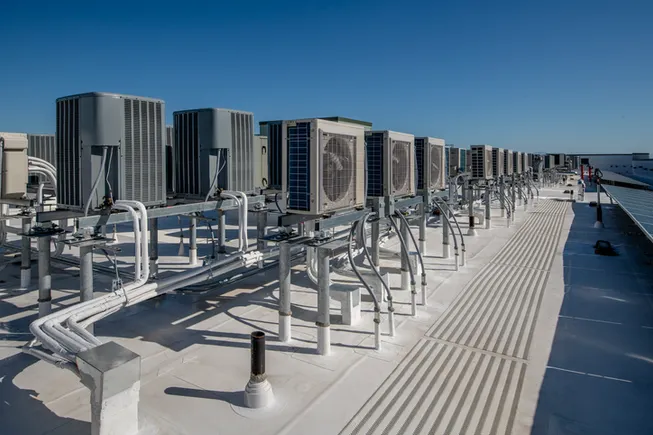
Not all heat pumps are the same—nor is every building suited to the same system. The success of a heat pump system depends largely on the facility's operating profile, climate zone, and available heat exchange sources. Urban density adds another layer of complexity: air-source heat pumps require significant exterior space, often on rooftops or building sites. Ground-source heat pumps (or geothermal) can add output capacity without requiring large outdoor areas, but they typically require deep vertical wells, which can increase construction costs.
Key Considerations:
- Hospitals: Require highly reliable, year-round systems. Water-source or ground-source heat pumps often provide stable water temperatures for critical spaces.
- Airports: Due to large, open spaces and variable occupancy, they benefit from air-source heat pumps with modular capacity or hybrid systems that can flexibly respond to rapid load changes.
- Schools: Predictable schedules make air-source heat pumps ideal, delivering significant energy and emission reductions.
- Mixed-Use or District Applications: Water-loop systems or centralized heat pumps can efficiently serve multiple buildings.
Understanding these drivers ensures each facility receives a technology configuration matched to its performance, resilience, and sustainability goals.
Scalable, Future-Ready Solutions
Heat pumps significantly reduce greenhouse gas emissions by minimizing or eliminating reliance on combustion heating,immediately advancinginstitutional sustainability goals. Schools, airports, and medical campuses are increasingly adopting heat pumps to meet stricter decarbonization requirements while improving indoor environmental quality. By integrating heat pumps, organizations can future-proof their infrastructure against ongoing regulatory changes and position themselves as leaders in environmental stewardship.
Oregon Health & Science University in Portland, Oregon, recently installed a heat pump in one of its central plants. The new equipment will capture heat from an adjacent building to heat a 170,000-square-foot patient care building, reducing energy and carbon emissions and bringing it closer to achieving long-term sustainability and carbon elimination goals.
The scalability of heat pump technology means it can be applied across entire facility portfolios, not only in new buildings but also as part of phased modernization strategies.
A Resilient Path Forward
The transition to heat pump technology is already underway in some of the nation's most energy-intensive facilities, such as hospitals and airports, demonstrating that this approach is operationally viable and economically sound. As adoption accelerates, a very real future is one where heat pumps could be used in every building across the country, transforming how we heat and cool the built environment while achieving substantial national emission reductions.
The conclusion? Heat pumps are more than just a technology upgrade; they are a strategic investment in resilience, sustainability, and leadership. For organizations ready to act, the future is clear—and electric.