
Current Hotel Union Fight Focuses on Pay, Next One May Be About Technology
At CES 2024, robot demonstrations attracted attention, but the culinary union delegation focused on their threat to employment. The current hotel strike centers on wages, but experts believe technology will be key in future negotiations. Union contracts already include technology protection clauses but do not restrict technology deployment. Automation is costly and its effectiveness is uncertain, making it unlikely to replace human labor in the short term, but optimizing employee experience through technology may become a trend.
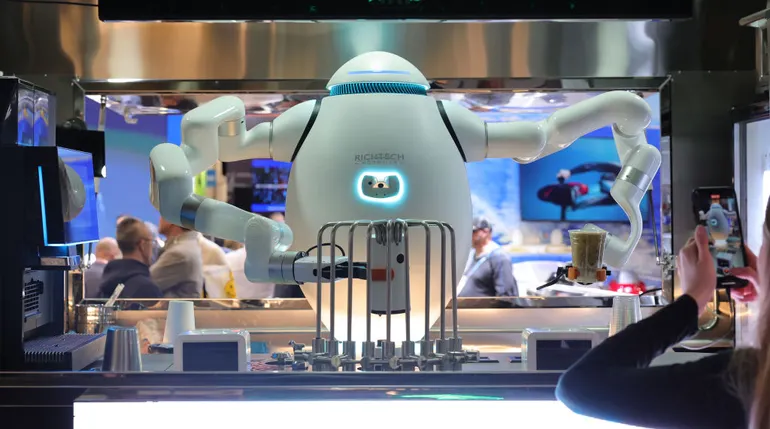
At CES 2024 in Las Vegas, a robot asked attendees, "How would you like your eggs?" When the audience responded, the robot skillfully cracked and cooked the eggs on demand. At the expo, another robot provided massage services, while another made lattes. These robot demonstrations captivated the 135,000 attendees, and related videos spread widely online, making it into the "coolest tech" roundups after the show closed.
However, a group of attendees did not come to be amazed. Delegations from Culinary Union Local 226 and Bartenders Union Local 165 — two Nevada chapters affiliated with the national hospitality union Unite Here, collectively known as the "Culinary Union" — came specifically to see which robots were performing service jobs held by their members.
"Everything I saw at CES, I asked myself: 'How will this affect workers and their jobs?' Nobody on the convention floor was talking about that," said Liz Shuler, president of the AFL-CIO, the largest federation of unions in the U.S., of which Unite Here is a member. Shuler gave opening remarks for a panel discussion at the Labor Innovation and Technology Summit (LIT Summit), held in Las Vegas in January concurrently with CES.
The Culinary Union, which represents about 60,000 Nevada workers, also attended the LIT Summit where Shuler spoke. A few months earlier, in November 2023, the union made headlines after winning historic wage increases following threats to strike at several major resorts on the Las Vegas Strip. The new contracts included technology protection clauses aimed at mitigating the impact of technology on members' jobs.
Outside Las Vegas, the ongoing hotel strikes in 2024 have centered mainly on wages — workers argue that current pay is insufficient to keep up with the rising cost of living — and on reversing pandemic-era staffing cuts. But hospitality and labor experts believe technology will become central to future union contract negotiations, rather than a side clause.
Meanwhile, the hospitality industry continues to adopt technologies that streamline operations, and the rapid pace of technological change makes it difficult to predict which technologies will become points of labor dispute in the future.

The threat of technology to union jobs
Concerns about technology replacing workers are nothing new. In the hospitality industry, this issue dates back to the invention of the automatic dishwasher in the mid-20th century, which streamlined kitchen operations and displaced dishwashers nationwide. Bill Werner, associate professor at the Harrah College of Hospitality at the University of Nevada, Las Vegas, told Hotel Dive.
However, in recent years, the development and adoption of hospitality-related technology has accelerated dramatically. According to an October 2023 study by JLL, hotel operators ranked technology upgrades as their top priority for 2024. Specifically regarding robotics in hospitality, the global market size is expected to reach $2.2 billion by 2030, with a compound annual growth rate of 21.5% from 2023 to 2030, according to Research and Markets.
At the LIT Summit in January, then-Unite Here president D. Taylor said he had attended CES for years, "but in 2017 I realized, 'Oh my god, if we don't address (the growing impact of technology), we're in big trouble.'"
The following year, the Culinary Union added a clause about technology adoption to its contracts. In the contracts negotiated in 2023, the union "protected and expanded" that clause, union spokesperson Bethany Khan told Hotel Dive.
For Culinary Union members, technology-related concerns go far beyond robot replacement, including workflow optimization apps and artificial intelligence. Although the union contract clause provides protections regarding how technology is used, it does not prevent companies from deploying new technology in the first place.
"There's nothing in the contract that restricts management from using automation," Werner said. "It's entirely up to the hotel. The contract only addresses the impact of technology on employees."
The current Culinary Union contract clause requires hotels to notify workers up to six months in advance before implementing any technology that could affect union members' jobs, including artificial intelligence. The contract also requires employers to train employees on new technology at no cost, and provides severance including six months of health and pension benefits if union workers are laid off due to technology.
The 2023 contracts also introduced workers' rights to negotiate over any technology that tracks employee locations or shares their data, and established the right for tipped workers to be compensated when technology prevents them from performing their duties.
"The Culinary Union has always led the fight for dignity of work," Khan told Hotel Dive.
Unite Here also added technology-related clauses in 2018, but according to a spokesperson, the latest round of negotiations did not expand or strengthen that clause. Werner believes this is because workers are focused on securing higher wages and reversing pandemic-era staffing cuts.
"This could become a bigger fight in the future," Werner said, adding that the newly signed Culinary Union contracts are valid for five years. "What will technology look like in five years? None of us know. I think when these contracts come up again... this will be a more critical issue because (hotels) will have more options in terms of automation, and the cost of automation."
Automation is not yet mature — for now
Although robot demonstrations stole the spotlight, they have not truly replaced hotel workers yet. Werner cited the case of the Tipsy Robot bar at The Venetian in Las Vegas. In early 2023, this robot bar went viral due to a TikTok video where user @uptin filmed an ordering screen that required a 10% service fee. "I usually don't mind an automatic 10% tip to make my drink, but you're a robot," he said.
"It became a local curiosity," Werner said, "but people I've talked to don't like (robot bartenders)... They pour weak drinks because they measure exactly one ounce. Every bartender in Las Vegas pours a little extra."
According to Werner, robot bartenders — like other hospitality robots showcased at CES — have not yet moved beyond the gimmick stage. "There's no real big shift to automation yet," he said, for several reasons. First, "the return on investment is not clear," because the industry is uncertain how customers will react.
Additionally, the cost of such robots is currently too high for many hotels. For example, the Richtech 'Adam' robot that served drinks at this year's CES costs $180,000, according to Inc. However, some robot applications make more sense for hotels, such as back-of-house food preparation where automation is easier, like chopping vegetables.
"(Costs) will come down," Werner said. "Technology will eventually catch up in price."

Optimizing the employee experience
For hotel employees, a more pressing technology issue than robot replacement is smartphone apps. Elena Newman, a housekeeper at the Mandalay Bay resort in Las Vegas, described at the LIT Summit her experience of being asked by managers to use an app that schedules cleaning tasks. Previously, housekeepers received paper lists of rooms and could decide the cleaning order themselves; the app, however, dictated when and where Newman cleaned.
"If the smartphone decides the cleaning order, it sends us to different floors, different areas," she said during the panel discussion. "Imagine pushing a heavy, fully loaded cart, running back and forth."
Newman described how she and her colleagues organized to resist the app, and eventually the resort backed down. "Smartphones don't clean rooms, we do," she said.
Meanwhile, many hospitality professionals say technology is improving staffing and process efficiency and, when deployed properly, can also improve the employee experience. According to the American Hotel & Lodging Association's (AHLA) 2024 State of the Industry report, hotels are seeking to use AI to streamline processes, maximize labor, and "revolutionize" operational efficiency "to accommodate the industry's growing need for multi-role flexibility."
When businesses use technology to take over rule-based, repetitive tasks, "employees are freed up to focus more on the emotional needs of guests," said Bob Vergidis, founder and chief vision officer at Point of Sale Cloud, a POS technology provider.
"If a guest is staying for the first time, the primary goal should be to turn them into a loyal fan who not only returns but also influences others. That's what humans excel at," he said. "We don't need more people pushing buttons; we need more people enhancing human connections."
Vergidis also believes that technology that reduces employees' cognitive load can serve as a retention tool, especially for Gen Z workers seeking a better work-life balance. According to an August report by Axonify, 64% of frontline hospitality managers said employees leave due to burnout.
Retention is a major concern for hotel managers, many of whom are struggling to fill open positions, according to AHLA. According to Alexander Mirza, co-founder and CEO of Mogul Hospitality, technology that successfully improves the employee experience can actually help alleviate ongoing labor shortages.
"We need bold innovation in human capital and leadership to solve (the labor shortage)," he said. "For example, how can the industry collectively recruit and develop talent, provide career growth for people, and potentially use AI to do that?"
Meanwhile, innovation continues to accelerate, with hotel operators adopting technology spanning concierge services, massage therapy, and more. Although new technology will be adopted whether unions like it or not, workers are likely to resist technologies that do not improve the employee experience.
"We will continue to enforce this technology clause," Khan told Hotel Dive. "Everyone deserves dignity of work, the opportunity to support a family, and job security — and we will continue to lead this fight for rights."
Visual editor Shaun Lucas contributed to this article.