
How Schools Without Lockers Are Reshaping Campus Architecture
Wayzata High School in Plymouth, Minnesota, permanently removed rows of lockers in the middle of corridors during its renovation, and many schools nationwide are following suit. K-12 architecture experts note that new high schools tend to avoid traditional full-school locker layouts, a trend that emerged before the COVID-19 pandemic, which accelerated its decline. Students no longer need lockers due to digital learning resources, but educators and parents still miss the social memories associated with lockers. Design firms are transforming former locker areas into collaborative spaces while retaining activity-specific lockers.
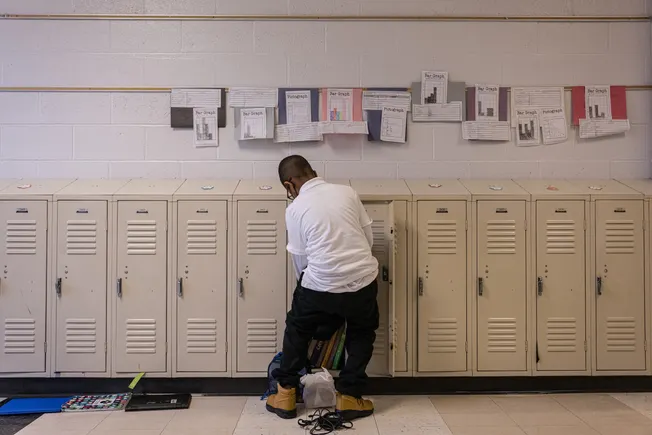
At Wayzata High School in Plymouth, Minnesota, hallways often feel crowded between classes as 3,700 students move through them. When recently planning a floor renovation, the school decided to permanently remove the rows of waist-high lockers that stood in the middle of the corridors.
Although students occasionally gather at lockers to chat briefly with friends or pull out homework for the evening in advance, almost no one actually uses them for storage.
Principal Scott Gengler said, "At some point, students generally felt there wasn't much need for lockers." When he became principal ten years ago, ninth graders were assigned lockers but rarely used them. Now, students across the school can request a locker as needed, but only about 100 apply each year.
Similar to Wayzata High School, schools across the country are gradually removing lockers or abandoning the traditional practice of assigning a personal locker to every student. K-12 building experts point out that new high schools are being designed with a preference for moving away from the classic "locker for everyone" layout. This trend existed before school closures due to the COVID-19 pandemic, and the pandemic further accelerated the decline of lockers.
For students, this makes sense—they rarely use their lockers anyway, and as school resources and homework become increasingly digital, everything they need for the day can fit in a backpack.
However, for educators and parents, this trend symbolizes an emotional end of an era. Their own high school memories are filled with decorating lockers, passing notes through the slits in the locker doors, and meeting friends at their lockers between classes.
Kipton Smilie, a professor of education at Missouri Western State University, says people's memories of lockers are usually quite vivid. He wrote a paper about the disappearance of social spaces in high schools, in which he mentionedthe decline in locker usagephenomenon.
He said, "A lot of our social life in school revolved around these lockers."
New uses for locker space
McMillan Pazdan Smith, an architecture firm based in South Carolina, currently oversees five new middle and high school projects, none of which use the traditional "locker for everyone" model, according to Ben Thompson, the firm's K-12 director and certified learning environment planner.
Thompson said that in the Southeast, the trend of declining locker demand has lasted a decade, and colleagues across the country report similar changes.
"The key is how to design the facility to maximize its effectiveness."
—Ben Thompson, K-12 Director at McMillan Pazdan Smith
Architects and planners no longer assume every student needs a locker; instead, they ask the school: Are lockers for all students, some students, or not at all? This question is raised early in the design process because lockers and the space needed to open them take up hallway area and affect student traffic.
Thompson said, "They really do affect the geometry of the hallway in multiple ways."
Spring Valley High School in Columbia, South Carolina, is also working with McMillan Pazdan Smith on plans to remove the rows of waist-high lockers in the middle of the hallways, replacing them with collaborative spaces featuring modern furniture that can be used for small or large group class projects, as well as for students to socialize.
Thompson said the goal is to make the space "more useful for students' daily activities."
He noted that building a school without lockers for everyone does not necessarily save costs. While the required building area may decrease and locker purchase costs may be reduced or eliminated, classrooms may need additional storage compartments, or hallways may need more space allocated for collaborative areas.
Additionally, sports programs, music classes, and career and technical education courses may still require lockers for specific purposes.
Thompson reiterated, "The key is how to design the facility to maximize its effectiveness."
Tim Shimp, an education learning designer at the global design firm DLR Group and a former district superintendent, said the use of traditional lockers is declining, with some schools shifting to an on-demand model where students can request one when needed. However, in schools that restrict backpacks in classrooms, students still use lockers in the traditional way.
Shimp said whether and how students use lockers "has become a big topic in school design discussions today."
From popularity to decline
There are several explanations for why school lockers have plummeted in popularity. The most common reason is the proliferation of 1-to-1 devices, e-learning platforms, and other digital resources, making it easy for students to fit everything they need for the day into a backpack.
Students also say that with limited time between classes, they don't want to make a detour to their lockers. School administrators strictly manage "passing time" between classes to maximize instructional time while ensuring students can get to their next class on time.
Jane McAlpin, a junior at Arcadia High School in Phoenix, Arizona, said she has never used a locker in high school because the school never offered the option—even though lockers line the hallways. Like her classmates, she carries all her textbooks, notebooks, and laptop in her backpack. If students have extra bags, such as sports equipment, they typically leave them in their first-period classroom and retrieve them after school.
McAlpin said if she had a locker, she might use it to store textbooks. "But then again, I'm sometimes already late because I have to run across campus," she said.
Educators also point to another trend contributing to the uselessness of lockers: teenagers' generalreluctance to wear coats。
Even at Wayzata High School in Minnesota, where winter temperatures often drop below freezing, Principal Gengler said, "I still don't understand why our kids don't wear jackets." He added that when explaining to ninth-grade parents that the school doesn't provide lockers to every student, the first question is often where their child will put their coat. Gengler tells them, "Well, that's a topic you'll need to discuss with your child."
Making room for learning and socializing
While schools and design firms consider transforming traditional locker areas into collaborative workspaces, they are also prioritizing flexible areas for teenagers to socialize with friends.
Missouri Western State University professor Smilie said this consideration is important given the role lockers have played in the social development and experiences of high school students in the past.
"In the past, at least for those five minutes, you had to interact with people, whether you wanted to or not, but at least you were physically close to others and had to learn to cope."
—Kipton Smilie, Professor of Education at Missouri Western State University
Smilie's research found that lockers in American high schools first became popular after the 1918 influenza pandemic, when schools tried to reduce the spread of viruses and diseases by storing students' coats, backpacks, and lunchboxes in lockers to help prevent infection. There was opposition at the time, with some arguing that rows of steel lockers were unsightly.
However, over time, lockers gradually became a common element of school decor and frequently appeared as props in school-themed movies in the late 20th century. Despite this, some administrators still worry that students might use lockers to hide prohibited items.
Smilie said memories of high school lockers may include positive experiences, such as arranging to meet friends at the locker between classes or decorating the door with posters of favorite bands; they may also evoke negative experiences, such as bullying, a lack of social belonging, or anxiety over forgetting the combination.
Additionally, lockers once facilitated forced social interactions and negotiation opportunities—students had to share lockers with others or ask someone in a crowded hallway to move so they could open their own locker door.
Smilie said, "In the past, at least for those five minutes, you had to interact with people, whether you wanted to or not, but at least you were physically close to others and had to learn to cope."
McMillan Pazdan Smith's Thompson said that in current school building design, community spaces serve both academic purposes and as social hubs.
Thompson said, "Kids are kids, and they still crave being with and socializing with their peers." When a space can serve both instructional and social functions, "that's the best scenario."
As for the lockers removed from Wayzata High School, some were recycled, some were sold, and the rest will be redeployed to other buildings in the Wayzata Public Schools district.
Principal Gengler has been observing student interactions between classes—lockers have already been removed from two of the school's four floors. He said that in hallways without lockers, student behavior is no different. "The social dynamics haven't changed at all," Gengler said.
He is considering placing high-top tables in locker-free hallways to encourage students to chat with peers between classes.
Now, he just wishes students would wear coats.
Greg Linch (data and visuals director) and Shaun Lucas (visual editor) contributed to this article.

